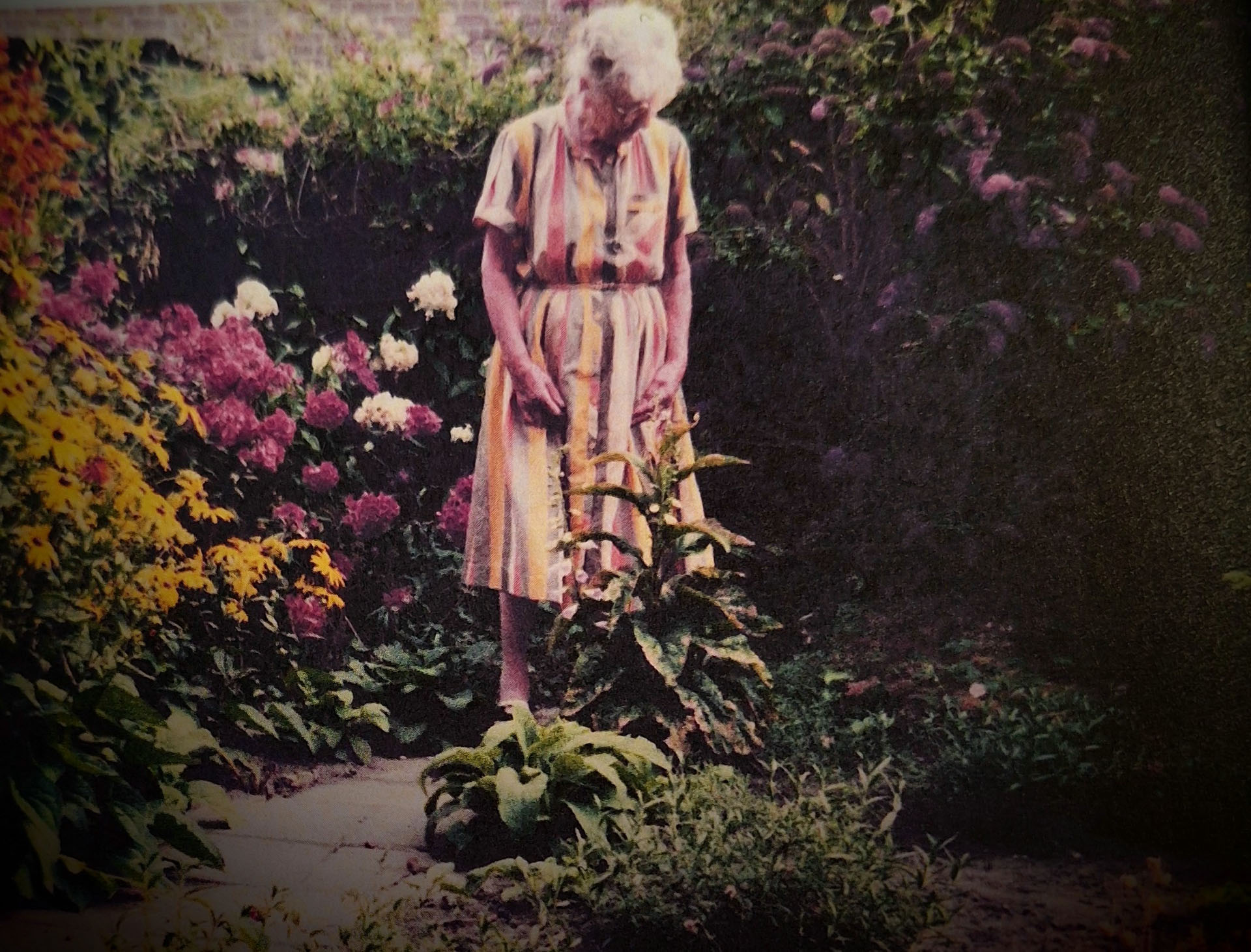
KRIMPEN AAN DEN IJSSEL – Following the presentation of the Lotte Stam-Beesesquare in this municipality, Frank Druijff asked to write an article about this remarkable urban planner for the spring issue: Van Yssel Tot IJssel, published by the Historische Kring Krimpen aan den IJssel (HKK).
With this article, I would like to draw attention to architect and urban planner Charlotte (Lotte) Ida Anna Stam-Beese (1903 – 1988). She lived in Krimpen aan den IJssel for twenty-five years. Despite her significant contribution to the reconstruction of the Netherlands, her work has long remained underexposed. Fortunately, that is changing. Lotte is, in fact, an important figure in 20th-century architecture.
Lotte
In this article, I choose Lotte rather than ‘Stam-Beese’ or ‘Mrs. Stam-Beese.’ I do this to bring her closer to the reader. To many in her circle, however, she remained ‘Mrs. Stam-Beese.’ People who knew her well say that, alongside her dominant traits, she radiated immense joy. She possessed a great deal of knowledge which she passionately tried to share. Looking back, we can only conclude that her achievements were unprecedented.
Lotte lived in Krimpen aan den IJssel from 1963 until her death in 1988. At IJsseldijk number 284 stood the dike house ‘Mijn genoegen’, situated next to the farmhouse of her daughter, the artist Ariane. The cottage formed a contrast with the modern flats in Overschie, the Zuidplein, and from 1960 onwards on Mendelssohnlaan in Hillegersberg, where she had lived previously.
The architect Reinier Stuffers, who as an urban planner has focused on the ‘urbanized polder landscape’ of Krimpen aan den IJssel, writes to Arjan Bosker (director at the municipality of Krimpen aan den IJssel):
“I did visit her once in the autumn of 1974. She wanted to meet the ‘new’ urban planner for the municipality.(…) She lived practically opposite Rook, the concrete mixing plant. She didn't consider that an urgent problem and said: “The IJssel is a workhorse,” which sounded like a beautiful alliteration in her accent.”
The mixed language Lotte spoke contained more German than Dutch. In her circle, it was also called ‘Lottisch’. She was born on January 28, 1903, in a railway station in the then German Reisicht Silezië. Her family saw this as a metaphor for her nomadic existence in the first half of her life. Her father was a civil servant in the service of the railways. Her mother was a Polish farmer's daughter. Lotte had an older brother and a sister.
Looking back on her childhood, she says that, "her development consisted to a significant extent of the relationship with her older sister, who was held up to her as an example of compliance and conformity at home and at school. She could not and did not want to be like that herself." Lotte had a great thirst for discovery and a hunger for adventure.
War
In August 1914, the First World War breaks out. Her brother then volunteers for the army. Her father's patriotism quickly turns sour when his son is killed in action in Russia in the very first year of the war. Lotte will have to miss her brother. Germany loses the war. The family fortune evaporates due to inflation. The war changes the lives of millions of Europeans.
When Lotte was 18, she faced a completely uncertain future – “I was adrift, uprooted, and displaced.” While her sister chose the security of marriage, Lotte went her own way. “I ate in soup kitchens among ladies-in-waiting from discarded royal houses, vagrants, war invalids, and young artists. Sometimes I unintentionally found myself caught up in street fights and mass demonstrations.” This changed her view of the world.
In 1924, in a weaving studio in Dresden, she heard about the existence of the Bauhaus. She enrolled as a student at this avant-garde educational institution. The training in Dessau provided direction for functional design in the service of a harmonious existence, whether it concerned furniture, tableware, or complete houses. The goal of the Bauhaus was not so much the search for a personal style, but rather the pursuit of unity among all the arts in the service of architecture. Through this, the artist would escape isolation and be able to work in the applied arts.
Study time
Once accepted, she received lessons in the weaving studio of the German-Swiss weaver and textile designer Gunta Stadler-Stölz (1897-1983), as part of the interior architecture department. Later, she studied architecture with the Swiss architect and urban planner Hans Emil (Hannes) Meyer (1889-1954), the director of the Bauhaus at the time. Lotte had a relationship with this married man. Despite the progressive atmosphere of the school, this relationship was not welcome. It was therefore better that she left the Bauhaus on January 1, 1929, without a diploma.
This period of study was of great significance to Lotte. “My life at the Bauhaus is an endless struggle like Don Quixote against windmills. It is your total commitment to turn everything upside down.” Her photographs from that time, which she herself considered the least important, received much appreciation in the 1980s. They are included in collections of, among others, Museum Boijmans van Beuningen in Rotterdam and The Museum of Modern Art in New York.
In August 1930, Hannes Meyer was dismissed from the Bauhaus because of his left-wing ideas. Disappointed, he decided to start a new life in the Soviet Union. He became a professor at the State Higher School of Construction and Architecture in Moscow and asked Lotte to join him. She did not last long there and returned to Brno after fierce arguments. Her first child, Peter (Beese), was born there in July 1931. After Lotte became active in the organization Levá Fronta (Left Front), in which various artists spoke out critically against the rising Nazism, she was expelled from Czechoslovakia in 1932. She then traveled to Kharkiv in Ukraine.
Architect
In Kharkiv, she met the Dutchman Mart Stam, a former teacher at the Bauhaus. They fell in love and started a relationship. He belonged to the May Brigade: a group of architects led by the German architect and urban planner Ernst May (1886–1970) who had been invited by the Russian government to develop new industrial cities and expand existing ones. In 1934, Mart Stam came into conflict with his clients and applied for an exit visa together with Lotte. They married shortly before their departure. In 1935, their daughter Ariane (Stam) was born.
Together, they founded the architectural firm Stam en Beese in Amsterdam in 1936. In October 1940, at the age of 37, Lotte began attending the Amsterdam Academy of Architecture to finally obtain her official architect's title. When Mart Stam began a relationship with a Jewish woman in hiding during the war, the marriage ended in 1943. Lotte continued to call herself Stam-Beese for the sake of name recognition. Her teacher, the architect Willem van Tijen (1894-1974), offered her temporary accommodation. She graduated as an architect under his supervision in October 1945.
In 1946, Lotte got a job at the Department for Urban Development and Reconstruction in Rotterdam. As chief urban architect, she worked with urban planner Cornelis van Traa (1899-1970) on the Basic Plan for the Reconstruction of Rotterdam. In this position, she left a significant mark on the city. Her most important urban designs for Rotterdam are: Kleinpolder (1947-1952), Pendrecht (1949-1952), and Alexanderpolder/Ommoord (1957-1971).
Het Nieuwe Bouwen/ New Building movement
Lotte was a prominent representative of the Nieuwe Bouwen movement, with an emphasis on functionalist urban planning, simple prefabricated homes in rows, open neighborhoods with ample green space, and houses oriented towards the sun. Saskia van Stein, Director of the International Architecture Biennial Rotterdam (IABR), writes to me: “As a female urban planner during the post-war reconstruction period, she was a striking figure who wanted to make a difference for many with her distinctive stamp—design—ideology.” In the green surroundings of the Kleinpolder neighborhood, she introduced the residential path to the Netherlands. This was new because it meant that access to homes was no longer necessarily located on the street side.
Pendrecht became most famous for its unique floor plan featuring the so-called stamp. This stamp is a rectangle of five residential blocks, a shape that Lotte constantly repeated on the floor plan (as if she were placing a stamp). Each rectangle contained housing types for families, the elderly, and single people. In doing so, she wanted to ensure that different types of people lived together everywhere. In Rotterdam, everyone was gripped by the optimism of the reconstruction. At that time, no one felt the need for nostalgia, which is now an important factor in new construction. After the traumas of the war, the desire to look forward prevailed—modernism was part of that.
In 1968, she formally retired, but she continued working half-days for the Service for another three years. During that time, she focused on the expansion plan for Rotterdam-East/Capelle aan den IJssel. These studies discussed a sub-city for 175,000 residents and envisioned an expansion into the municipality of Krimpen aan den IJssel. Sketches from 1960 show a second river crossing to the village. The metro line from Capelle aan den IJssel was also extended in a loop to Krimpen. For the village center of Krimpen, this marked the end of a sultry night at T’Enge and a hopeful new beginning for the Crimpenhof shopping center.
A Lotte Stam-Beesegarden
In 1968, she received the Wolfert van Borselen Medal. A year later, she was appointed Knight in the Order of Orange-Nassau. From 1971, now truly retired, she devoted herself to designing gardens for friends and acquaintances. In the biography written by cultural historian Hanneke Oosterhof, it reads: "The garden (700 m²) that Lotte designed for the Vreugdenhil family at their new bungalow 'Opus vier' in Krimpen aan den IJssel remains remarkably intact to this day. (2018) The bungalow was part of a series of 27 bungalows on the residential island of Langeland, designed by architect A. van der Lek from Capelle aan den IJssel.” According to experts, this should be on the Burgemeester Lepelaarssingel. Other examples where her philosophy is visible today are the tilt flats and the car-free paths between residential blocks.
By then, criticism had also emerged regarding the functionalist New Building movement. Residential courtyards and the so-called cauliflower structure with circular streets came into vogue in the early 1970s. This was an architecture that definitely did not appeal to Lotte. In the twilight of her career, there was very little interest left in her work. This led to isolation. When Lotte died on November 18, 1988, she was 85 years old.
Heritage
In 1992, a street in Rotterdam was named after her. Currently, there are plans in Rotterdam Ommoord to pay tribute to Lotte with a memorial. In Krimpen aan den IJssel, no streets have been named after important women (with the exception of the Royal Family). I have been told that there are no women on the municipality's list of potential future street names either. Lotte's small house, which was adapted according to her design, was recently demolished. What remains are two folders containing drawings and documentation at the Nieuwe Instituut in Rotterdam.
Together with the Municipality of Krimpen aan den IJssel, I recently presented the 'Lotte Stam-Beeseplein.' This is a village square that exists (for now) only in the world of our imagination. We have the opportunity to further develop Lotte's philosophy. When privatized space fails to keep pace with the demands of the times, we must build our ideals over it through the air. With unprecedented optimism, we can collaborate on spaces — for this and that.
Edwin Stolk – visual artist
I wrote this text in the context of my research cardio_vision 2024, a search for the face of Krimpen aan den IJssel with The performance 2025 and the presentation of the imaginary Lotte Stam-Beesesquare 2025/2026.
Sources:
Book: ‘Want de grond behoort ons allen toe’, Leven en werk van stedenbouwkundig architecte Lotte Stam-Beese
Auteur : Hanneke Oosterhof
Uitgever : Vantilt
Publicatiedatum : 2018
ISBN: 978-94-6004-400-7
Book: Lotte Stam-Beese, 1903-1988: Dessau, Brno, Charkow, Moskou, Amsterdam, Rotterdam
Auteurs: Anne-Mie Devolder, Hélène Damen en Lotte Stam-Beese
Uitgever : Uitgeverij De Hef
Publicatiedatum : 1993
ISBN: 90-6906-014-0