Artist Edwin Stolk often works on-site, responding to existing situations driven by a fascination with the social implications of his artistic practice. At times, he creates a new environment, as he did in 2017 with *Basiskamp Entre Nous* at KiK (Kunst in Kolderveen). He is currently developing a new project in the Brugse Poort district of Ghent, reporting on his research and the ideas emerging from it.
BRUGSE POORT GENT – As an artist, I am constantly seeking compelling starting points for the imagination. Each time, it is a battle against isolation and an attempt to break the silence. Today, the cobbled streets of the Brugse Poort provide space for my thoughts. I am a stranger here, a seeker. The physical gate that gave this Ghent neighborhood its name has been erased by time. Everyone seems to come from ‘elsewhere’ yet has been here before. For a year, the neighborhood organization De Koer serves as my courtyard—the base from which I move.
I gained access to this multilingual reality through an appeal on Facebook. A professional jury judged it positively. This was the starting signal for an engaging process of imagination. My actions do not simply accept boundaries and have destructive sides alongside beautiful ones. Nothing and no one exists on their own, and this automatically leads me to the other. Now I must break through the individual, and it is a matter of searching for the collective conditions for imagination.
This working-class neighborhood attracts me. Somewhere, this district was described as a twilight zone between dream and nightmare. With the available money, I do not buy meaning the way real estate agents do. It provides me with a baseline to search for other forms of value. This allows me to continue building like the farmers who previously moved here from the countryside and later the guest workers who came, or today's migrant workers from Eastern Europe who settle in this neighborhood. A home for many is forming here. In that respect, the Brugse Poort can be called complete. It surprises me that this is rarely seen as a quality.
I spoke with a Moroccan baker about his long working hours. We both did our best to bridge the language barrier. While the scent of his loaves completely captivated me, it turned out he had no time to meet up later at De Koer. I understood that. My actions begin here, a voice inside me said. Because where daily duties consume all time, political fiction has free rein. The discussion surrounding the traffic circulation plan, for example, tore a hole in the social fabric and was deployed in a polarizing way. The ‘knip’ (closure) at the Bargiebrug partly blocked car traffic to the shops in the Bevrijdingslaan. The ‘cargo bike generation’ hung posters behind their windows stating that they liked being ‘cut’ (geknipt), and so they stood opposed to one another.
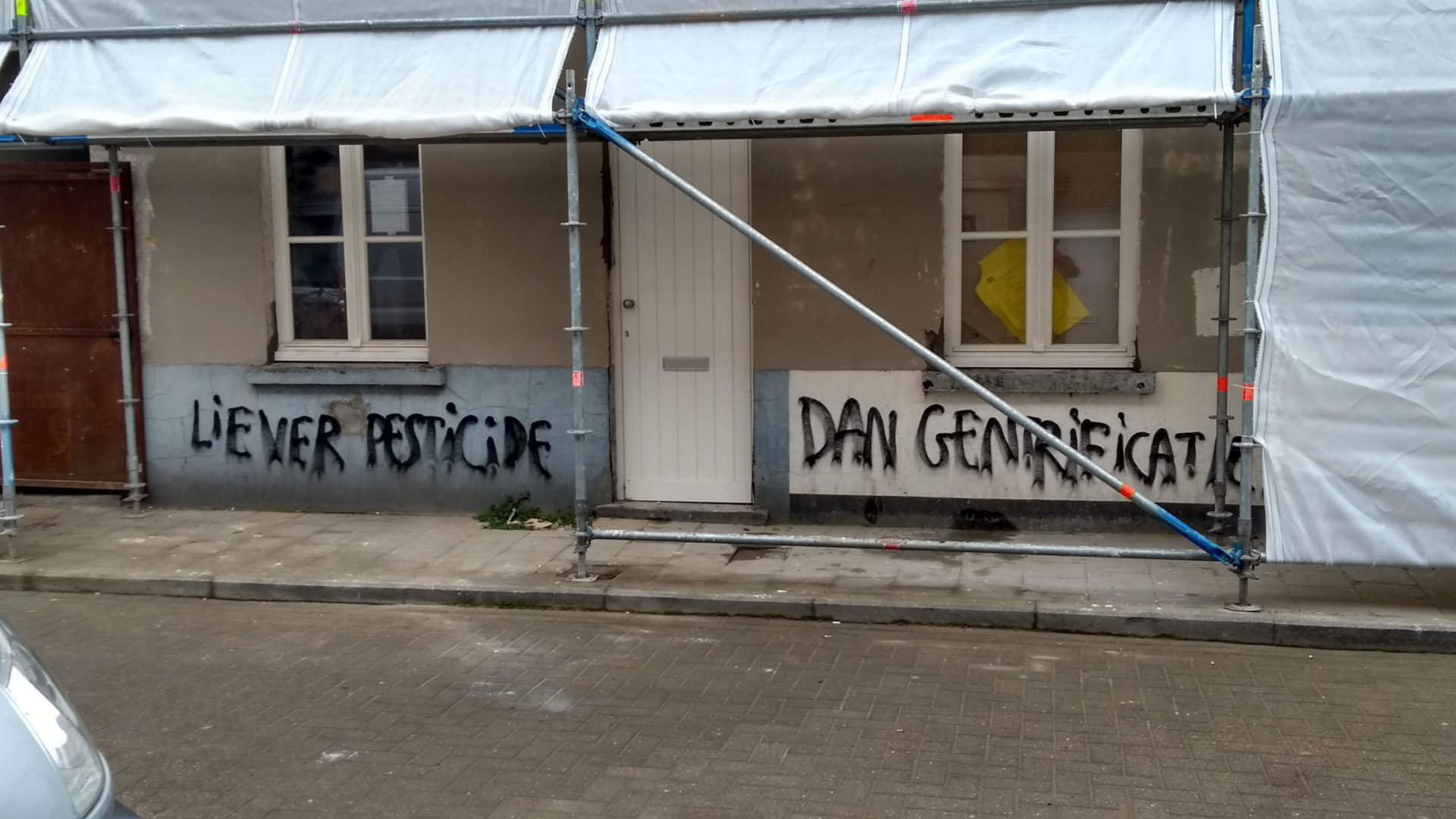
As a title for my observations, I chose ‘Het luizengevecht’ (The Lice Fight). It refers to a marginal confrontation. This name originally comes from a 19th-century working-class alley (beluik) in this neighborhood. People lived there in great poverty and poor hygiene. The people of Ghent mockingly called the alley ‘Het Luizengevecht’ because so many lice supposedly lived there that they had to fight for a spot. In 2002, the alley and the people who lived there had to make way for the urban renewal plan ‘Oxygen for the Brugse Poort’. With this plan, the City of Ghent created green spaces in multiple locations within the densely built environment. Today, you will therefore find a small park at this location. The ghost of gentrification lurks in this neighborhood daily.
With my work, I want to add something. Art is not one-sidedly subservient to government policy, the market, or city marketing. Art introduces difference in places where thinking has become stuck in rigid patterns. Where the polarization initially deterred me, I suddenly recognized the urgency. I spoke with a neighborhood worker about the way different groups do or do not feel heard by politics. In an article, I read that the multicultural society is said to be primarily a construction of tolerance, in which people live alongside each other rather than with each other. The housing market in the Brugse Poort is rapidly traveling from the low to the average and higher market segments. This causes new fights at the margins. Despite everything, the social resilience of this district is dedicated to the anarchistic character of this neighborhood.
De Vinkenzetting (the finch singing competition)
When I read about finch sitting, the puzzle pieces fell into place for me. This is an ancient traditional sport also briefly called ‘zetting’ (sitting). The finch sitting was often organized by pub owners. The finches are still placed in competition cages in a long row along the roadside. After the starting signal, each participant counts the number of “songs” or “trills” of his or her neighbor's bird for an hour. A song must at least consist of an intro (voorzang) and a closing flourish (slotzang) that ends with the characteristic “suskewiet”. Advanced strategies are used to achieve this. Some finches sing foreign songs. Their song is therefore not valid at finch competitions in Flanders.
In the past, there were competitions in the Brugse Poort along the Groendreef and the Leiekaai. I find this intangible heritage a beautiful metaphor for the way the population composition or ‘setting’ (zetting) is strategically engineered in the neighborhood today. After all, not all residents sing the “suskewiet” in the desired manner. Here, the bird is a striking symbol for migration. Certain ‘birds’ disappear, and this is called urban flight. The City of Ghent does everything it can to preserve their native song.
Inspired by the ‘poetic terrorism’ of Hakim Bey, my idea for De Zetting was born. High time, therefore, to take the lead from the café of De Koer for an ode to the Brugse Poort! On the weekend of October 5 and 6, we ask residents of the Brugse Poort to let the bird sound of their choice echo from their homes. In this way, the streets will be filled for an hour between 11:00 and 12:00 with the sounds of native and foreign bird species. When many respond to this call, a poetry will arise that will be unprecedented and out-of-zone—a moment of listening to the language of diversity.
Edwin Stolk – visual artist
THE PLACING - was developed in collaboration with the people from social and cultural centre De Koer. It was an artistic attempt to influence the experience of public space. With the participants of 'De Zetting', we paid tribute to the multilingualism of this neighbourhood. This art project was made financially possible by: The City of Ghent and Arts Flanders.
[The fight on the margins and the art of listening was published on the Jegens & tegens website 26-03-19]
[Photo: Edwin Stolk]