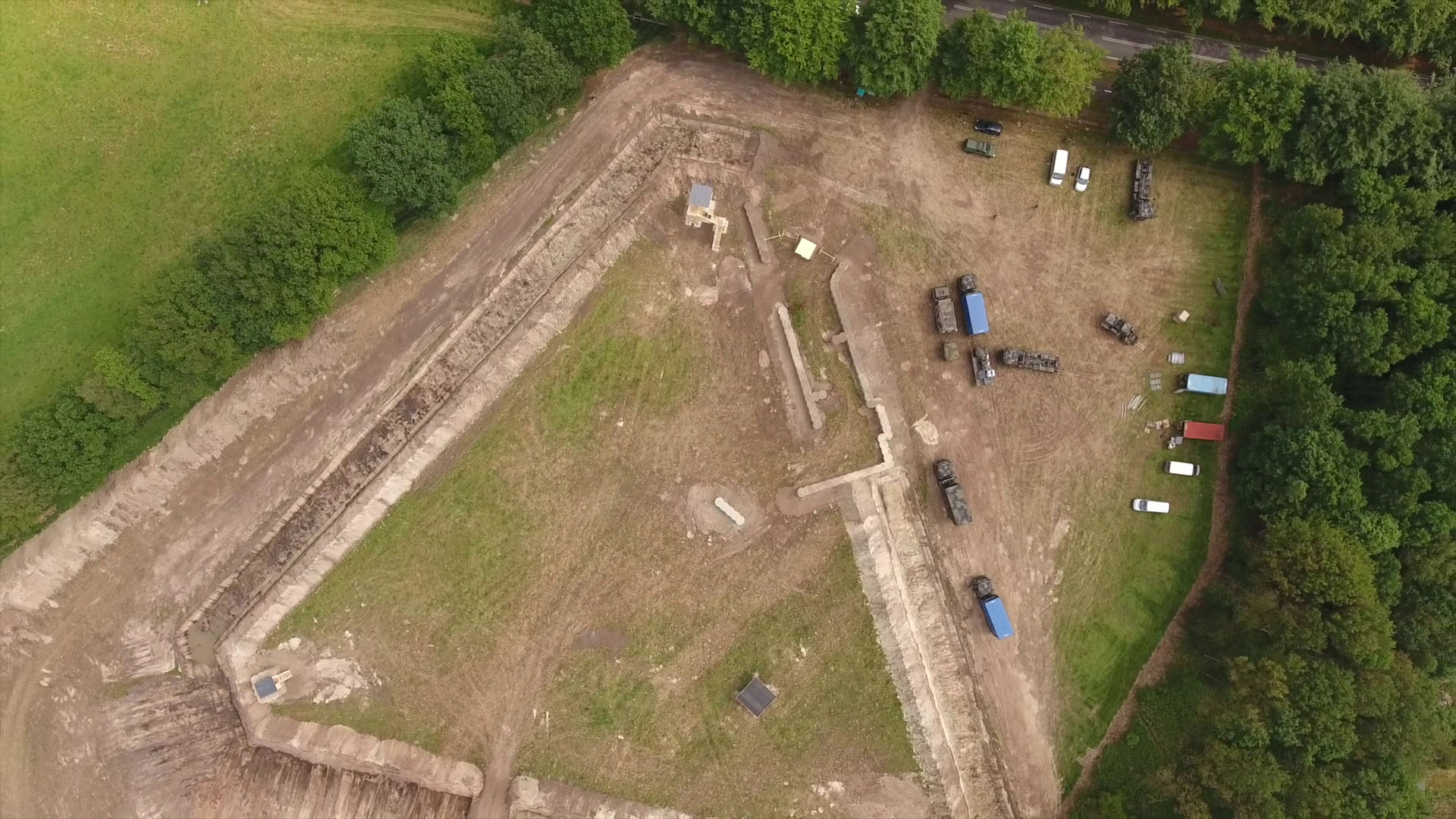
Artist Edwin Stolk often works on location, responding to existing situations driven by a fascination with the social implications of his artistry. Sometimes he creates a new environment, such as in 2017 with Basiskamp Entre Nous at KiK (Kunst in Kolderveen).
FREDERIKSOORD – Populism, migration, climate change, existential insecurity—the urgent issues we face today—call for the investigative gaze of an artist. The more radically I immersed myself in what is called the ‘art world’ during my art education, the less interested I became in this parallel ‘reality’.
It is my conviction that art must be able to temporarily relate to the forces at play in societal ‘reality’. Art also has a journalistic function; I view the outcomes of my practice as context-dependent. As a service provider, I concern myself with the social fabric of a village, town, or neighborhood. In doing so, I work closely with people active in a particular place—people at companies, the government, and residents. This is also known as the democratic triangle.
Omdat deze kunst raakt aan de macht van besluitvorming, ontstaat niet zelden frictie. De hedendaagse kunstenaar wordt bijna nooit op initiatief van beleidsmakers uitgenodigd. Fondsen houden de hand op de knip wanneer het kunstwerk niet voldoet aan de voorwaarden van de ‘white cube’. Ze stellen soms zelfs de harde voorwaarde dat een werk niet politiek mag zijn.
Because this art touches upon the power of decision-making, friction frequently arises. The contemporary artist is almost never invited at the initiative of policymakers. Funds are reluctant to provide funding when the artwork does not meet the conditions of the ‘white cube’. They sometimes even impose the strict condition that a work must not be political.
In the publication Basiskamp Entre Nous 2017, a humanitarian mission in my own country, I describe the imaginative process of such an investigative art project. The base camp drew attention to the almost forgotten history of the Society of Benevolence and linked this to an investigation into the welfare state of tomorrow.
In 1818, the Society of Benevolence ensured that the Dutch state, rather than the church, would be responsible for the well-being of its subjects. This gave rise to the welfare state we all know today. In 2013, during the Speech from the Throne, King Willem Alexander referred to the changing welfare state as a participation society for the first time. This description was the result of a political discussion regarding the affordability of the welfare state and aligned with planned cuts to the system. No one further explained how this participatory model works in practice. With the art project Entre Nous, I wanted to investigate this. After all, the success of a participation society requires a context in which one is willing to do something for others.
The art project was realized based on the idea that knowledge and resources in a participatory society can be made available in service of a societal goal, outside of market logic. Just as neighbors provide informal care to their single neighbor, I wanted to facilitate a conversation ‘between us’ with this art project. Base Camp Entre Nous was realized after three years of negotiations and was the sum of the contributions of active participants.
In ‘Het schootsveld’, a text that is part of the Entre Nous publication, written by art historian, advisor, and curator of public art projects Nils van Beek, he writes: ‘Base Camp Entre Nous was an apparition – it revealed what was and was not possible, and where people did and did not find each other within these possibilities.’
The base camp as a ‘truth procedure’ has taught me that it is possible to ‘arm’ art in an alternative way. With the process description of Basiskamp Entre Nous, I therefore hope to champion the possibilities that can arise from a multidisciplinary openness of the societal field.
Base camp Entre Nous 2014 - 2017
Base camp Entre Nous 2017 was the end result of an artistic process that lasted three years. For a month, a contemporary experimental colony appeared in a meadow near Frederiksoord. As with humanitarian missions abroad, the Ministry of Defence built a military base camp. Twelve artists lived here, working on social issues in this area in exchange for a salary.
Consider topics such as elderly care, for instance in the municipality of Westerveld where people live relatively far apart, or the effects of a shrinking region on education. Over five weekends, there was an extensive public program in which welfare state-related topics were discussed. The strength of this artwork lay above all in the informal space that emerged, where new encounters took place during the artistic process. New forms of truth-finding could thus emerge.
This art project was realized through a unique collaboration at this location. Shareholders of this movement included the Royal Netherlands Army, the Society of Benevolence, the Municipality of Westerveld, the Province of Drenthe, and many local businesses, organizations, and volunteers. Base Camp Entre Nous was financially supported by, among others, the Province of Drenthe and the Mondriaan Fund. The art project was executed in collaboration with the KiK Foundation (Kunst in Kolderveen) and conceived by artist Edwin Stolk.
This text "Art as 'truth procedure'" was published on the website: ArtEZ Platform for Research Interventions of the Arts (APRIA)
[Photo: Defensie]